

Text Entry Question
What's on this page
About Text Entry Questions
Text entry questions allow you to collect open-ended responses from your respondents.
Qtip: By default, the maximum number of characters permitted in a single text entry field is 20,000. However, you can change the character limit to be less than 20,000 if you apply custom validation to the question.

Variations
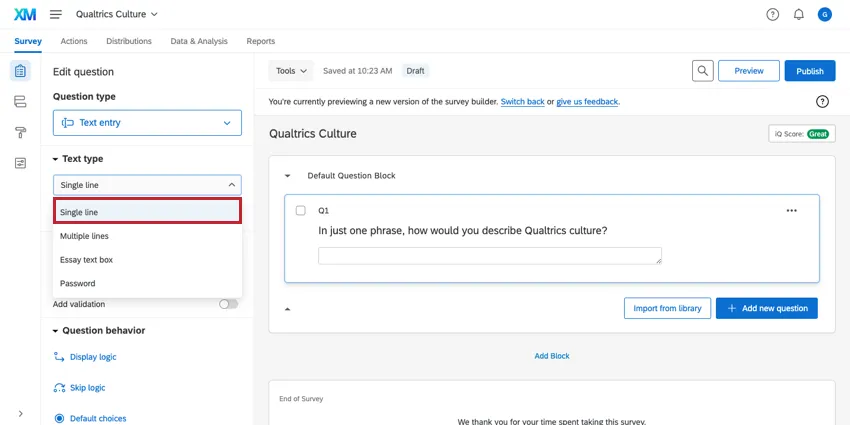
The text entry question has several variations that change the size and type of the text box. You can access these variations under Text Type in the question editing pane.
Single Line
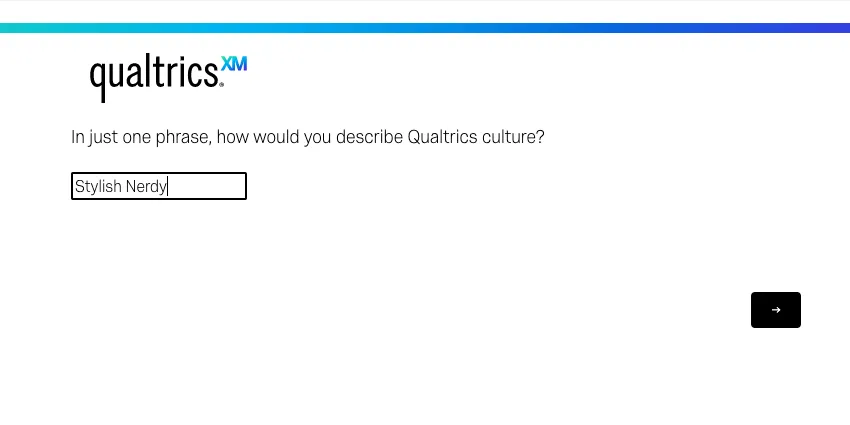
The single line variation provides respondents with a 1 line text box. While respondents can write responses well beyond the limits of the box, the single line format encourages a more succinct answer.
Multiple Lines and Essay Text Box
The multiple lines and essay text box variations provide respondents with multiple lines, encouraging respondents to provide a longer response. As you can see below, this change is not reflected in the editor, but in the preview of the question.
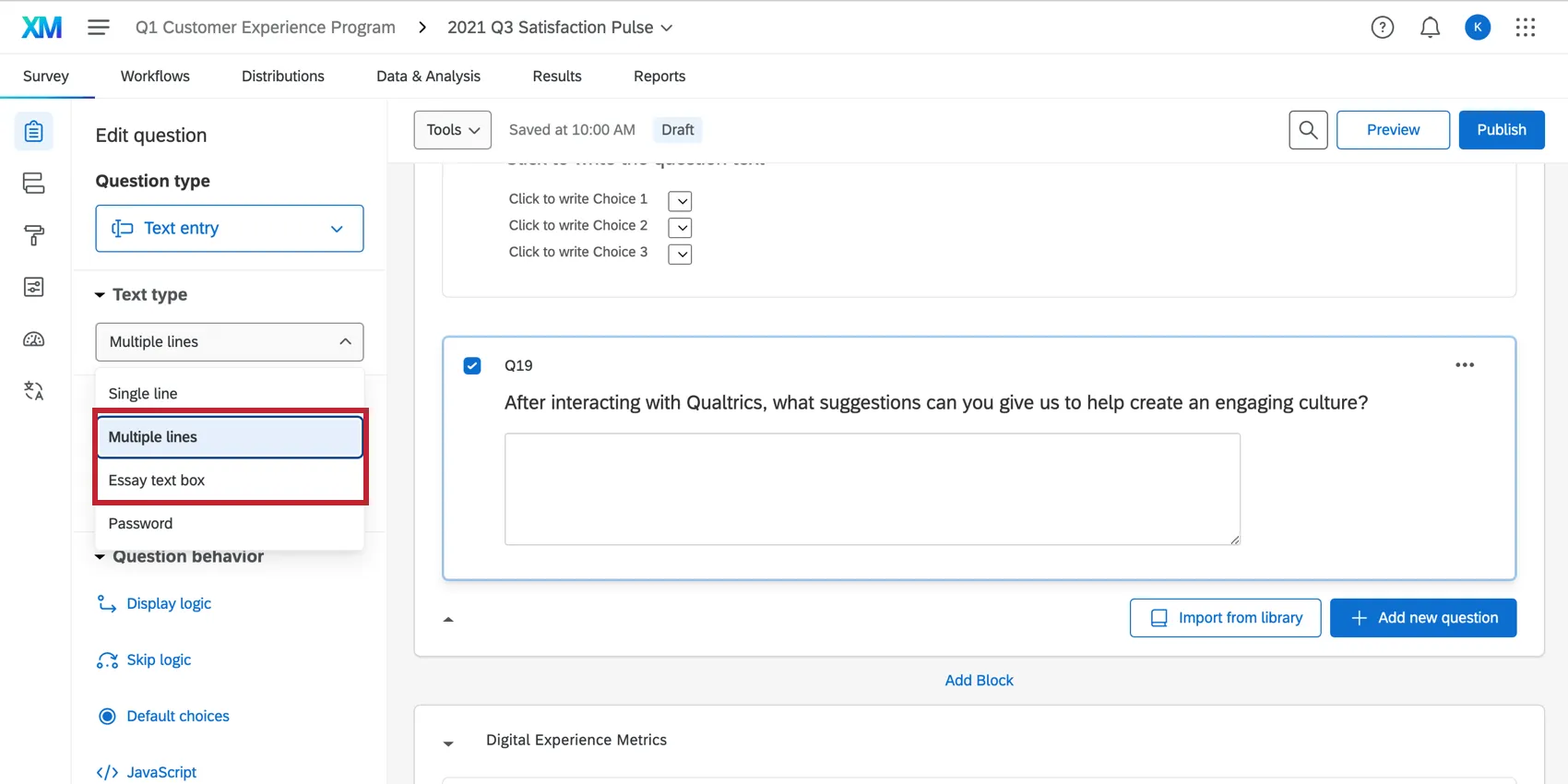
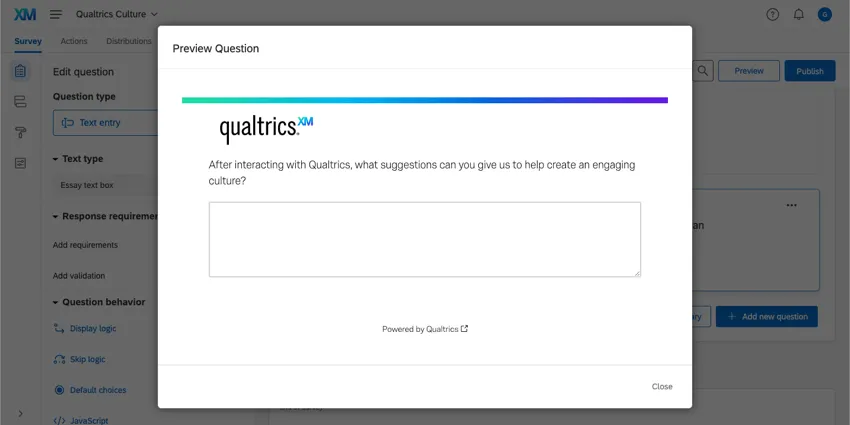
Qtip: “Essay text box” and “Multiple lines” refers to a default size that will be set, so long as you do not resize the text boxes. If you click and drag the handle on the bottom-right of the text box, you may make essay text box and multiple line text boxes as tall and as wide as you need to, making these two variations interchangeable. Note that once you resize a text box, you cannot reset it to its default size except by manual resizing.
Password
The password variation provides a single line text box. Any characters typed into the text box are disguised by dots.
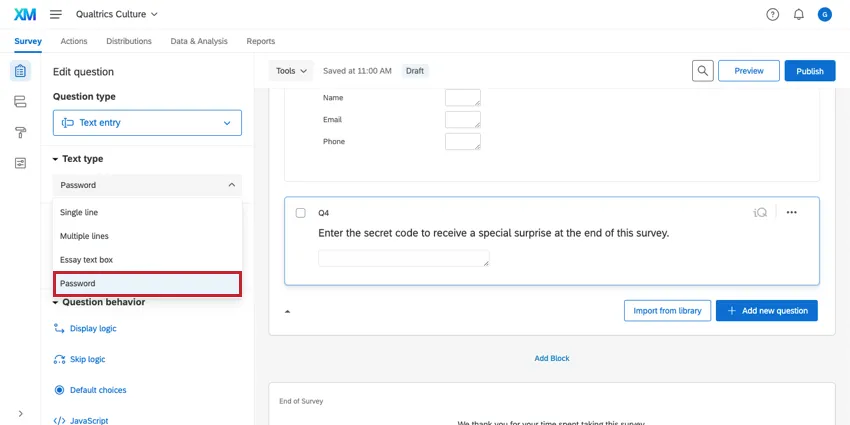
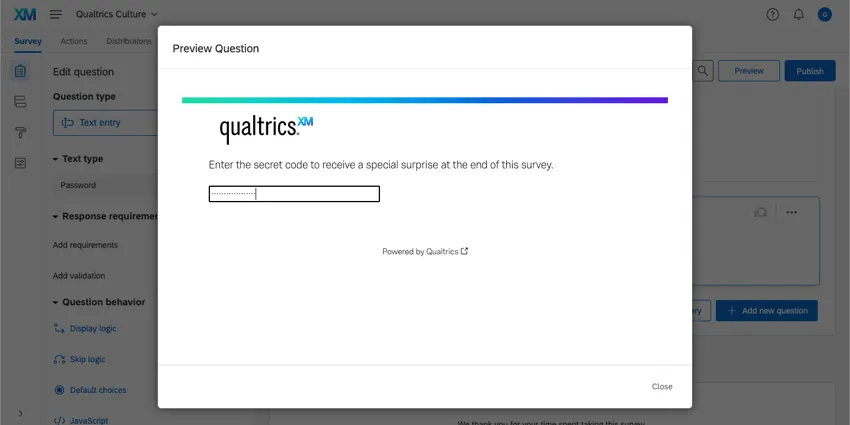
Qtip: Want to save individual passwords for users? Want the survey to check that the participants have the right passwords before they can respond? Consider using an authenticator instead.
Autocomplete
Autocomplete is a text entry variation that draws on a list of preexisting answers to provide recommendations to respondents of what they should answer. Autocomplete works a bit different from other text entry types, so it requires a specific setup. To learn more, see Autocomplete Questions.
Conversational Feedback
For more information, such as setup steps, see Conversational Feedback.
Text Entry Validation
Text entry validation, found under the Response requirements in the editing pane, is unique compared to other types of question validation.
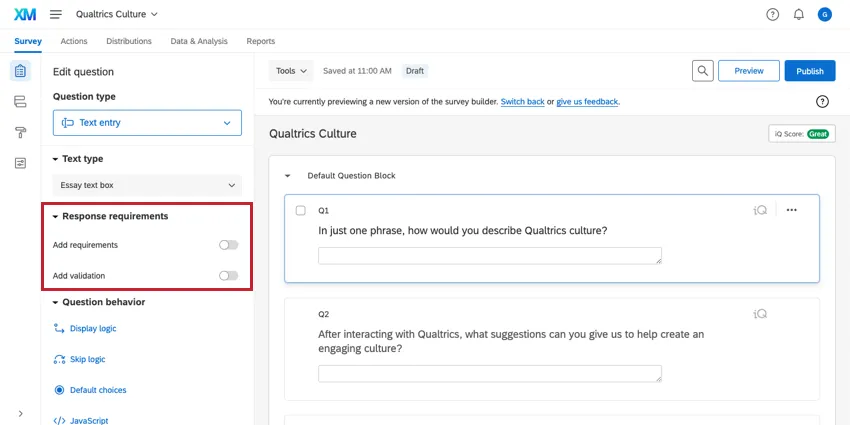
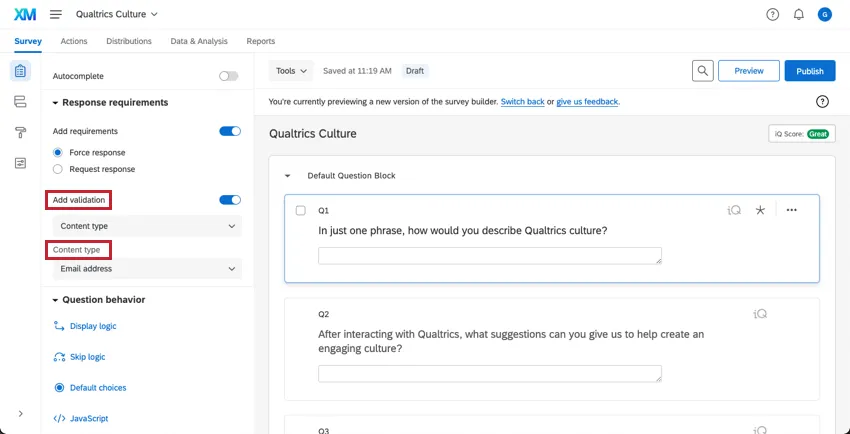
Once you toggle Add validation to the blue “on” setting in this area, you can specify the exact type of response you want (e.g., set Content type to only accept answers in the format of an email address) or a specific length for the response (e.g., 200 characters). Respondents will not be able to move past the question until a correctly formatted response has been entered.
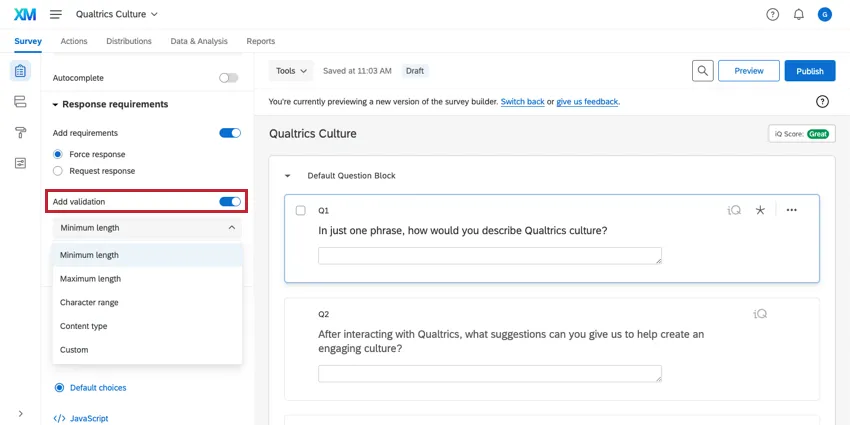
Qtip: To select from the content type option, first click Content type under Add validation.
Attention: Content validation is only available for single line text entry questions as well as multiple choice questions with text entry enabled.

Data Analysis
Once your responses have been collected, Qualtrics offers various methods to create reports and analyze your data.
Text iQ
You can analyze your text responses using Text iQ to surface sentiment, topics, and other enrichments on the content of your responses. These results can then be displayed in a report or a dashboard.
Reporting
In results dashboards, there are 3 widgets available for text entry questions: word cloud, response ticker, and record table.
In reports, you can use the word cloud and results table visualizations.
Downloaded Data Format
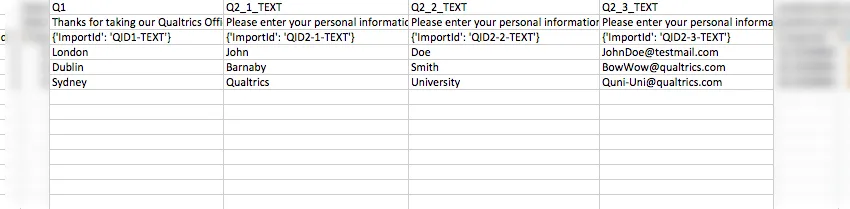
Each text entry box in your survey will be shown as a column in your downloaded data. For most variations, there will be only one text box and so only one column for the question in your file. For the form field, there are multiple text boxes, and so there will be multiple columns.
Conversational Feedback Data
For details, see Data Output for Conversational Feedback.
FAQs
What kind of project can I use this type of question in?
What kind of project can I use this type of question in?
Can I use display logic to limit which survey respondents can see Adaptive Follow-up questions?
Can I use display logic to limit which survey respondents can see Adaptive Follow-up questions?
Yes. When you enable Adaptive Follow-up on a Text Entry question, you can use display logic to limit which survey respondents are able to see generated follow-ups.
Where can I find more information about the safety and security of AI features?
Where can I find more information about the safety and security of AI features?
The Qualtrics Trust Center contains our most detailed documentation of the inner workings of AI features. Specific feature guidebooks are also available at the Trust Center.
I want to enable Adaptive Follow-up on a question in a live survey. What steps should I take?
I want to enable Adaptive Follow-up on a question in a live survey. What steps should I take?
- Enable and configure adaptive follow-up on your survey question.
- Complete a preview response, making sure to add additional detail when prompted by generated questions.
- In the Data and Analysis tab, go to "Field Editor," select "Create Field," and select the "Combine” tab. Select the original open text field and the new concatenated open text field to create a new merged field. See Combining Fields for more information.
- Review the new embedded data field in Data and Analysis. Publish changes on the survey.
- Go to any impacted dashboards and replace the existing open text field with the new concatenated field (can be found under Derived Data).
How do Response Clarity and Adaptive Follow-up determine which language the respondent is using?
How do Response Clarity and Adaptive Follow-up determine which language the respondent is using?
We look at the current language that is selected in the survey session. If the respondent is taking the survey in one language and enters their response in another language, their response may be flagged as “Unintelligible answer”.
When should I use Response Clarity or Adaptive Follow-up? When should I use both?
When should I use Response Clarity or Adaptive Follow-up? When should I use both?
There’s no set rule for when to use either or both features, but below are some considerations:
- If you are concerned about increasing the length of your survey, enable Response Clarity only.
- If you are getting mixed-quality responses, enable both Response Clarity and Adaptive Follow-up with “Too generalized answer” and “Lacks details” turned off for Response Clarity.
What types of Text Entry questions are good candidates for Response Clarity and/or Adaptive Follow-up?
What types of Text Entry questions are good candidates for Response Clarity and/or Adaptive Follow-up?
In all cases, it is important to choose questions that offer sufficient context. Avoid enabling these features on overly broad questions, such as "Why?" or "Tell us more," as they are poor candidates for effective intervention. Instead, use these features on questions that are more specific, such as "Please tell us about your experience during your last store visit."
That's great! Thank you for your feedback!
Thank you for your feedback!